







Smoking, the Bladder and the Heart: The Men’s Health Risk Most Guys Never Hear About
Smoking significantly impacts bladder health, increasing the risk of urothelial cancer. Understanding these risks can lead to better prevention and early…
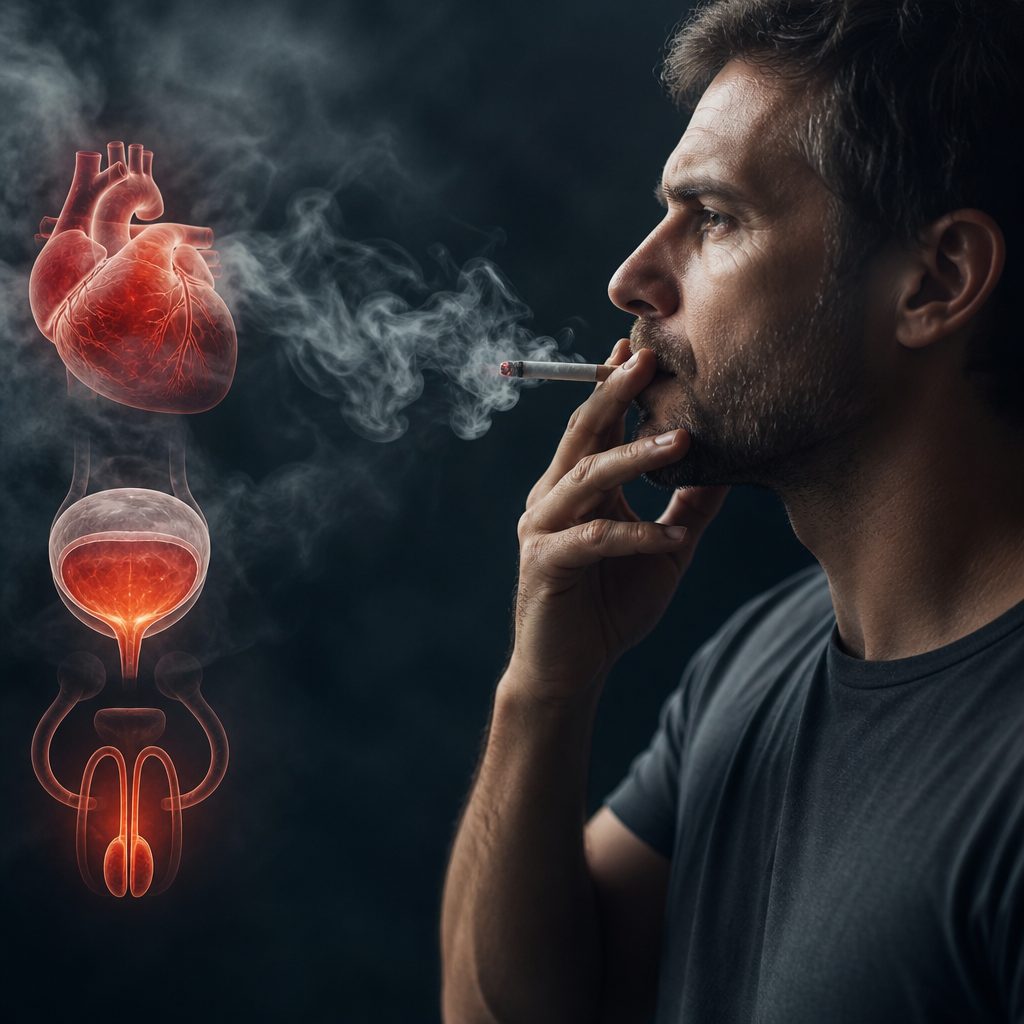
Ask a man what smoking does to his body and he will almost certainly say “lungs,” and probably “heart” if he has had a check-up recently. Very few mention the bladder. Yet among urologists, tobacco is treated as the single most consistent lifestyle factor behind urothelial cancer — the cancer that lines the bladder and the upper urinary tract. The chemicals from tobacco smoke do not stay in the chest. They are absorbed, filtered by the kidneys, and then sit in contact with the bladder wall until the next trip to the bathroom. That is the part of the story that rarely makes it onto a cigarette packet.
Why the bladder takes the hit
The bladder is a storage organ, and storage is exactly the problem. Carcinogenic compounds that enter the bloodstream from smoking are excreted in urine, which means the lining of the bladder is bathed in them repeatedly, for hours at a time, over decades. Risk tracks with how much and how long a person has smoked, and it does not vanish the day someone quits — it declines gradually over years. That lag is not a reason to keep smoking; it is a reason to stop earlier rather than later, because every year of exposure is additive.
The early warning sign is almost embarrassingly simple: blood in the urine. It is usually painless, often intermittent, and frequently dismissed because it appears once and then disappears for weeks. Other signs include needing to urinate far more often than usual, a burning sensation without a clear infection, or an infection that keeps coming back after treatment. None of these automatically mean cancer — kidney stones, enlarged prostate and ordinary infections all cause similar symptoms — but all of them deserve a proper work-up rather than a wait-and-see approach, especially in a current or former smoker over 45.
What a sensible work-up looks like
- A urine test to check for blood, infection and abnormal cells.
- Imaging of the kidneys, ureters and bladder to look for stones, masses or obstruction.
- Cystoscopy — a thin camera passed into the bladder — which remains the most direct way to inspect the bladder lining.
- Review by specialists in cancer imaging and pathology if anything suspicious is found, so the diagnosis is based on more than one opinion.
The prostate conversation is separate — and it needs its own appointment
Men often collapse “men’s health” into one vague worry, but prostate cancer is a different conversation from bladder cancer and should be handled as such. PSA (prostate-specific antigen) testing is a blood test, not a diagnosis. A raised result can reflect benign enlargement, inflammation or recent cycling as easily as cancer, which is why the sensible approach is a discussion about personal risk — age, family history, ethnicity — followed by repeat testing and imaging where indicated, rather than a single number driving panic or false reassurance.
Treatment has become far more graduated than the old choice between radical surgery and nothing. Focal approaches such as high-intensity focused ultrasound (HIFU) target a defined area of the prostate rather than removing the whole gland. Radiation has moved in the same direction, with stereotactic radiotherapy delivering tightly shaped doses over a small number of sessions, and adaptive techniques adjusting the plan to day-to-day changes in anatomy. The practical implication for patients is that the right question is no longer “surgery or radiation?” but “which approach suits this tumour, this gland and this man’s priorities?” — a question best answered by a multidisciplinary team rather than a single clinician.
Testicular cancer: a different age group, a different habit
Testicular cancer behaves unlike the others. It tends to appear in younger men, often between the late teens and the late thirties, and the usual presentation is a painless lump, swelling or a change in firmness or heaviness in one testicle. Causes include factors such as undescended testis in infancy and family history. The useful habit is a monthly self-check in a warm shower, rolling each testicle between thumb and fingers to learn what normal feels like, so a change is noticeable. The one rule that matters: a new lump is a reason to be examined promptly, not a reason to monitor it privately for three months.
The heart and the urinary tract share the same risk list
What makes smoking so corrosive is that it damages several systems with the same exposure. The vascular effects — stiffer arteries, inflamed vessel walls, blood that clots more readily — raise cardiovascular risk while the same compounds are being filtered through the urinary tract. Obesity and poor sleep compound the picture, since both drive metabolic changes that make hypertension, diabetes and surgical complications more likely. For readers who want the cardiovascular side explained in plain clinical terms, the patient education material from Cleveland Clinic Abu Dhabi on the Effects of smoking on heart is a useful starting point, and the same hospital’s Cancer Institute runs dedicated genitourinary programs — testicular, prostate and bladder/urothelial — where diagnosis, surgery, medical oncology and radiation oncology are coordinated through tumour board review, alongside an obesity program and weight and sleep resources for the lifestyle factors sitting underneath it all.
If you are considering treatment in another country
Men in the Gulf and beyond increasingly compare options across borders, and specialist cancer care is one of the most common reasons people travel. Before booking anything, check the financial side carefully — people are often surprised to learn that a home insurance policy may not stretch as far as they assume once they leave the country, particularly for planned procedures rather than emergencies. Ask what pre-authorisation is required, whether follow-up imaging back home is covered, and who holds your records if treatment is split between two systems.
It is also worth understanding how academic cancer centres are structured, because the model explains the quality difference. Teaching hospitals such as Brigham and Women’s Hospital in Boston combine clinical care with research and training, which is why case review by a panel of specialists is standard practice rather than a courtesy. When you are choosing where to be treated, asking “who reviews my case, and how often?” tells you more than any brochure.
Four things worth doing this month
- If you smoke, set a quit date and ask for pharmacological support — willpower alone has a poor track record.
- Treat any blood in the urine as a reason to see a doctor, even if it happens once.
- Learn what your testicles normally feel like, and act on changes within days, not months.
- Have the PSA conversation before the age at which you might need the test, so the decision is informed rather than reactive.
None of this is dramatic medicine. It is attention: noticing a symptom, booking the appointment, and giving the body one fewer daily insult to absorb. This article is general information, not personal medical advice — the specifics of your risk belong in a conversation with a clinician who can examine you.