






Crypto Swap Fees Explained: Exchange Rates, Network Fees, Slippage and Price Impact
Understanding crypto swap fees is essential for maximizing your returns. Learn about the various costs involved, including exchange rates, network fees, and…
Key takeaways
- A crypto swap has up to six separate costs: the exchange spread, the platform commission, the blockchain network fee, price impact, slippage and, on cross-chain routes, a second network fee on the destination chain.
- The number that matters is the amount of cryptocurrency that lands in your receiving wallet, not the advertised commission. A platform charging 0% can still deliver less than one charging 0.5%.
- Typical all-in cost for a liquid pair ranges from roughly 0.1% to 1%. Thin altcoin pairs, congested networks and large orders can push this well past 2%.
- Slippage and price impact are different things. Price impact comes from your order size against available liquidity. Slippage comes from the price moving between quote and execution.
- Slippage tolerance is a ceiling, not a target. Setting it too tight causes failed transactions that still cost gas; setting it too loose authorises a worse price than you intended.
- Network fees vary by orders of magnitude between chains. The same stablecoin swap can cost cents on a layer-2 network and several dollars on Ethereum mainnet during congestion.
- Fixed and floating rates are not cheaper or more expensive by default. Fixed rates price certainty into the spread; floating rates leave you exposed to the market until execution.
Cryptocurrency platforms advertise low fees and competitive rates, and both claims can be true while you still receive less than you expected. The gap sits in the places the headline number does not cover: the spread built into the quote, the gas paid to the blockchain, the price movement caused by your own order, and the market movement that happens while the transaction is confirming.
This matters most for people who run a crypto swap regularly, move assets between networks, or handle amounts where a fraction of a percent is real money. On a $200 swap, a 1% difference is two dollars. On a $200,000 swap, it is two thousand.
The short answer to "what does a crypto swap cost": for a liquid pair on an efficient network, expect somewhere between 0.1% and 1% all-in. For an illiquid pair, a congested network, or a large order relative to available depth, the figure can exceed 2%. The rest of this guide explains where each component comes from and how to measure it before you commit funds.
What are crypto swap fees?
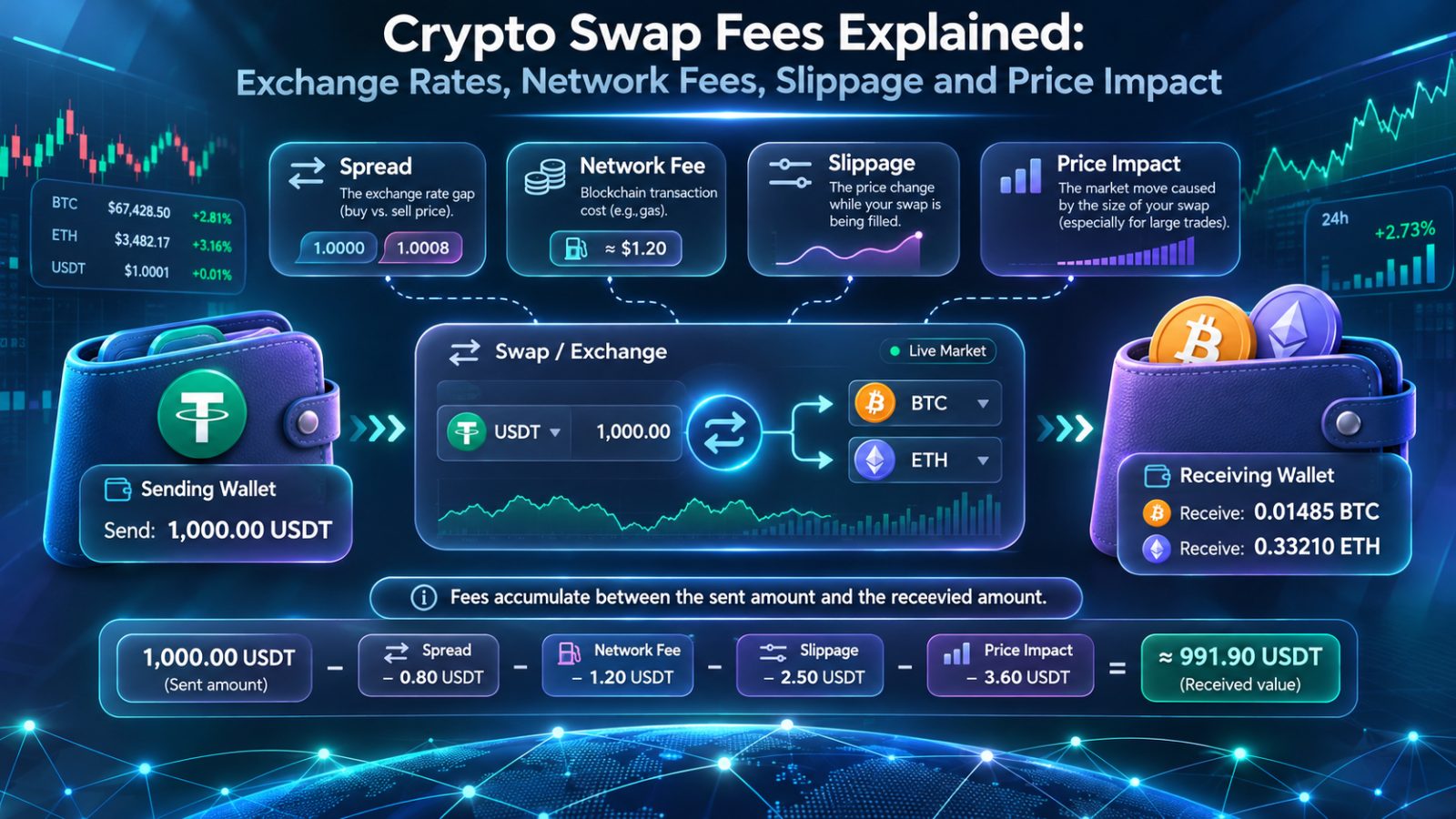
Crypto swap fees are the total set of costs deducted between the amount you send and the amount that arrives in your receiving wallet. Some are explicit line items; others are embedded in the exchange rate you are quoted and never appear as a separate charge.
There are six components. A given platform may charge all of them, bundle several into one quote, or absorb some entirely.
The six components of swap cost
|
Component |
Who receives it |
Typical range |
Usually included in the quote? |
|
Exchange spread |
The exchange or liquidity provider |
0.1%–1.5% on liquid pairs; higher on thin pairs |
Yes — embedded in the rate |
|
Platform commission |
The platform |
0%–1% |
Sometimes shown separately |
|
Source-chain network fee |
Blockchain validators or miners |
Cents to tens of dollars, chain-dependent |
Often paid by you, outside the quote |
|
Price impact |
Liquidity providers and the market |
Negligible to several percent, size-dependent |
Shown on DEX interfaces; rarely on instant swaps |
|
Slippage |
The market, or whoever fills your order |
0%–your tolerance setting |
No — bounded by "minimum received" |
|
Destination-chain network fee |
Validators on the receiving chain |
Cents to tens of dollars |
Varies by provider |
Two practical consequences follow from this table.
First, a platform that advertises "zero fees" has not eliminated cost; it has moved cost into the spread. That is a legitimate pricing model, but it means the commission figure tells you nothing useful on its own.
Second, costs can be double-counted if you are not careful. If a provider already includes the outgoing network fee and its own margin inside the quoted output amount, adding those figures again when you compare providers will overstate the cost and lead you to the wrong choice.
The only comparison that is reliable is the net amount received, measured for the same input amount, the same pair, the same destination network and at approximately the same moment.
Why do exchange rates differ between platforms?
Exchange rates differ because platforms do not share a single price source. Each one draws on its own order books, liquidity providers and pricing logic, and each applies its own margin on top.
Suppose Bitcoin has a reference market price of $100,000. One service might price conversions using an effective BTC value of $100,350; another might use $100,600. Both will describe their rate as competitive. The 0.25% gap between them is invisible on a $500 swap and costs $2,500 on a $1 million one.
What is a spread, and who pays it?
A spread is the difference between the reference market price of an asset and the price a service offers you. It compensates the provider for sourcing liquidity, operating the service, and carrying market risk between the moment it quotes you and the moment it closes its own position.
In many instant-swap services, the spread replaces an explicit commission entirely. This is why reading a fee schedule rarely tells you what a swap will cost.
How to calculate the effective exchange rate
The effective rate is the rate you actually transacted at, derived from the amounts rather than from what the interface displayed. Calculate it like this:
> Effective rate = amount sent ÷ amount received
> All-in cost % = (1 − (amount received ÷ expected amount at reference price)) × 100
A worked example. You convert 5,000 USDT into ETH. The reference market price is 1 ETH = 2,500 USDT, so the frictionless output would be:
> 5,000 ÷ 2,500 = 2.00 ETH
The platform delivers 1.98 ETH. The effective rate is:
> 5,000 ÷ 1.98 = 2,525.25 USDT per ETH
And the all-in cost is:
> (1 − (1.98 ÷ 2.00)) × 100 = 1.0%
That 1% is the sum of everything: spread, commission, any network fee the provider absorbed, and any slippage during execution. Without a line-item breakdown from the platform you cannot attribute it to a single cause, and for comparison purposes you do not need to. The 1% figure is what you compare against the next provider's figure.
Why the headline rate is not the number to compare
The displayed rate is a starting point that has not yet had network fees, price impact or execution slippage applied to it. Two platforms can display identical rates and deliver outputs that differ by 1%.
Compare outputs. Specifically, compare the field labelled "you receive", "estimated amount" or "minimum received", and then account separately for any fee you will pay from your own wallet.
What are blockchain network fees, and who receives them?
A blockchain network fee is a payment to the network's validators or miners for including and confirming your transaction. It goes to the network, not to the exchange, and no platform can waive it on your behalf — it can only absorb it into its own pricing.
Bitcoin charges transaction fees based on the size of the transaction in bytes and the current competition for block space. Ethereum and EVM-compatible chains charge gas, priced as a unit cost multiplied by the computational work your transaction requires. A swap on a decentralised exchange is computationally heavier than a simple transfer, so it costs more gas than sending the same token.
Why network fees fluctuate
Network fees move for reasons unrelated to the platform you use:
- Demand for block space rises and falls, sometimes within minutes.
- Network congestion increases the fee needed for timely inclusion.
- Transaction complexity matters. A multi-hop swap routed through three pools costs more gas than a single-pool swap.
- The fee market mechanism differs by chain. Ethereum's base fee adjusts per block; Bitcoin's fee market is a straightforward auction for space.
- The chain you select for sending or receiving changes the figure entirely.
How much does a swap cost on different networks?
The table below gives order-of-magnitude ranges rather than live figures, because network fees change continuously. Treat them as a guide to relative cost, and check current conditions before a large transaction.
|
Network |
Simple transfer |
On-chain swap |
Notes |
|
Bitcoin |
Cents to a few dollars; tens of dollars in heavy congestion |
Not applicable natively |
Fee depends on transaction size in bytes, not value sent |
|
Ethereum mainnet |
Low single-digit dollars typically |
Several dollars to tens of dollars at peak |
Most expensive mainstream option for swaps |
|
Arbitrum, Base, Optimism |
Cents |
Cents to low single-digit dollars |
Layer-2 networks settling to Ethereum |
|
Solana |
A fraction of a cent |
Typically well under a cent |
Very low fees; token and route support varies |
|
Tron |
Under a dollar typically |
Limited DEX ecosystem |
Widely used for USDT transfers |
|
Monero |
A fraction of a cent |
Not applicable natively |
Fee is small and largely independent of amount |
The practical lesson: for stablecoin movement, the network you choose often matters more than the platform you choose. A $5 saving on gas is a 1% saving on a $500 swap.
One caveat that costs people real money. A cheaper network only helps if both the service and the recipient support that exact asset-and-network combination. USDT on Tron and USDT on Ethereum are different deposit addresses on different networks. Sending tokens through an unsupported network is one of the few genuinely unrecoverable mistakes in crypto.
Are network fees included in the swap quote?
This depends entirely on the provider, and it is worth checking explicitly.
A swap can involve up to three separate network fees:
- The fee to send your deposit from your own wallet to the service. You pay this yourself, from your own balance, and it is almost never in the quote.
- The fee to execute the conversion. On a decentralised exchange you pay this; on an instant-swap service it is usually absorbed into the quoted rate.
- The fee to send the output to your receiving wallet. Most custodial and instant-swap services include this in the quote; some deduct it separately.
When you compare providers, confirm which of these three the quote covers. A provider whose quote looks 0.3% worse may actually be better if it covers an outgoing fee the other one deducts afterwards.
Cross-chain swaps: the second gas fee people forget
On a cross-chain swap — Ethereum to Solana, say, or BTC to an EVM token — the output arrives on a network where you may hold no native token. You cannot move it, swap it again, or pay for anything until you acquire some of that chain's gas asset.
This is not a fee on the swap itself, but it is a real cost of the swap, and it catches people out regularly. Before a cross-chain swap, check whether you already hold gas on the destination chain. If not, factor in the cost of obtaining it, which may mean a second transaction.
What is slippage, and how does it differ from price impact?
Slippage is the difference between the price you expected when you submitted a swap and the price at which it actually executed. Price impact is the amount by which your own order moves the execution price because of its size relative to available liquidity.
They are frequently conflated, and the distinction is practical rather than academic: price impact is predictable before you trade, and slippage is not.
What causes slippage?
Slippage occurs when conditions change between quote and execution:
- Prices move quickly during volatility.
- Liquidity thins out while your transaction is pending.
- Blockchain confirmation takes longer than anticipated, widening the window.
- A large order consumes several price levels as it fills.
- Automated market maker pools reprice as other trades execute ahead of yours.
For instance, you are quoted 1,000 units of a token and receive 990. That is 1% negative slippage relative to the estimate, assuming no other cost explains the difference. Slippage can also be positive: if the market moves in your favour between quote and execution, you receive more than estimated.
Slippage vs price impact: side by side
|
Slippage |
Price impact |
|
|
Cause |
Market or liquidity changes between quote and execution |
Your order size relative to available liquidity |
|
Predictable in advance? |
No — it is a range, bounded by your tolerance |
Yes — most DEX interfaces display it before you confirm |
|
Can it be positive? |
Yes |
No — it is always a cost |
|
Worse in volatility |
Yes |
Not directly |
|
Worse with large orders |
Indirectly |
Yes, directly |
|
How to control it |
Set slippage tolerance; reduce the confirmation window |
Reduce order size; split the order; use a deeper venue |
A large swap can have significant price impact in a completely stable market. A small swap can experience significant slippage during a volatile minute. Both matter most when you are trading less liquid assets.
What does slippage tolerance actually control?
Slippage tolerance is the worst execution price you authorise in advance. It does not set a target price or make execution more likely at a good price — it sets a floor below which the transaction will fail rather than execute.
On most interfaces, your tolerance setting is what produces the "minimum received" figure. If the actual output would fall below that number, the transaction reverts.
This produces an asymmetry worth understanding. A loose tolerance does not cost you money every time; it costs you money in exactly the cases where something goes wrong, and it authorises the full gap in those cases. Whoever fills your order at the edge of your tolerance keeps the difference.
What tolerance should you set?
There is no single correct figure, because the right setting depends on the pair's liquidity and the current volatility. The ranges below are a starting point, not a recommendation for any specific trade.
|
Pair type |
Common tolerance range |
Trade-off |
|
Major stablecoin pair on a deep pool |
0.1%–0.3% |
Rarely fails; very little room for loss |
|
Major asset pair (ETH/USDC, BTC/USDT) |
0.3%–0.5% |
Occasional failures during volatility |
|
Mid-cap token, reasonable liquidity |
0.5%–1% |
Balance between failure rate and exposure |
|
Low-liquidity or newly launched token |
1%+ often required to execute at all |
Authorises a materially worse price; highest risk |
|
During sharp market moves |
Higher settings may be needed |
The cost of certainty of execution rises |
The honest framing: raising tolerance to get a transaction through is a decision to pay more in exchange for execution. That is sometimes the correct decision. It should be a conscious one.
Why a failed swap still costs you gas
Gas pays for the network's attempt to process your transaction, not for a successful outcome. If a swap reverts because the price moved past your tolerance, the network still did the computational work, and the fee is not returned.
This is why an extremely tight tolerance is not a free safety measure. On a congested network, repeatedly failing and retrying a swap can cost more in wasted gas than the slippage you were trying to avoid.
What hidden costs appear in a crypto swap?
Beyond the main components, several costs appear only in specific circumstances. They are not hidden in the sense of being concealed; they are hidden in the sense that most people do not think to look for them.
|
Cost |
When it applies |
How to handle it |
|
Token approval transaction |
First time you swap a specific ERC-20 token on a specific contract |
A separate on-chain transaction with its own gas; unavoidable, but one-off per token and contract |
|
Failed transaction gas |
Swap reverts on slippage, insufficient gas, or a stale quote |
Set tolerance deliberately; refresh quotes before confirming |
|
Slippage beyond the estimate |
Price moves between quote and execution |
Treat "minimum received" as your actual floor, not the estimate |
|
MEV extraction |
Public mempool transactions on EVM chains, especially larger ones |
Use a private transaction route or MEV-protected RPC where available |
|
Destination-chain gas |
Cross-chain swaps |
Hold a small gas balance on the destination chain before swapping |
|
Minimum amount shortfalls |
Deposit arrives below the service's minimum |
Check the minimum before sending; account for your wallet's outgoing fee |
|
Exchange withdrawal fee shortfall |
Funding a swap directly from an exchange withdrawal |
The exchange deducts its fee, so less arrives than you entered; send a margin above the minimum |
|
Rounding and dust |
Small amounts, many decimals |
Negligible individually; noticeable across many small swaps |
|
Repeat conversions |
Multi-step routes done manually |
Plan the route first; every hop adds a spread and a network fee |
Token approval transactions
Before a smart contract can move an ERC-20 token on your behalf, you must grant it an allowance. That approval is its own on-chain transaction with its own gas cost, separate from the swap.
It is a one-time cost per token per contract, so it amortises if you trade the same pair often. On a single first-time swap of a small amount on Ethereum mainnet, the approval can represent a meaningful share of total cost.
MEV and sandwich attacks
On public blockchains, pending transactions are visible before they are confirmed. On EVM chains, this creates an opportunity: an observer can place a transaction immediately before yours and another immediately after, profiting from the price movement your trade causes. This is commonly called a sandwich attack, and it is one form of maximal extractable value, or MEV.
The cost shows up as slippage, which is why it is easy to misattribute. A generous slippage tolerance on a large, visible swap defines exactly how much is available to extract.
Several wallets and routers now offer private transaction submission or MEV-protected endpoints, which reduce exposure by keeping the transaction out of the public mempool until inclusion. If you are swapping a significant amount on an EVM chain, it is worth checking whether your interface offers this.
Dust, minimums and rounding
Every service enforces a minimum exchange amount, set so that network fees can be covered and the transaction can be processed. Minimums are usually small — in the region of a couple of dollars equivalent on major pairs — and are typically calculated dynamically from current network fees.
The practical risk is not the minimum itself but the interaction between the minimum and your wallet's fee behaviour. If a wallet deducts the network fee from the amount you entered rather than adding it on top, the service can receive less than you intended, and a deposit below the minimum may be held pending manual handling.
How do you read a swap quote screen?
Most interfaces show the same handful of fields under different names. Knowing which one is binding saves money.
|
Field |
What it usually means |
Is it binding? |
|
Rate / exchange rate |
Price before fees and execution effects |
No |
|
You receive / estimated amount |
Expected output under current conditions |
No — it is an estimate |
|
Minimum received |
The floor set by your slippage tolerance |
Yes — below this the transaction fails |
|
Network fee / gas |
Estimated cost of the on-chain transaction |
Estimate; actual cost depends on execution |
|
Price impact |
How much your order size moves the price |
Calculated at quote time |
|
Route |
Which pools or venues the swap passes through |
Affects both gas and price impact |
|
Quote expiry / timer |
How long the quoted rate holds |
Yes, where a provider offers a locked rate |
If you take one habit from this guide, make it this one: read "minimum received", not "you receive". The first is a commitment; the second is a forecast.
Fixed vs floating rates: which is cheaper?
Many exchange services let you choose between a fixed and a floating rate. Neither is cheaper as a rule. They price different things.
|
Feature |
Fixed rate |
Floating rate |
|
Exchange price |
Locked for a defined window, subject to the provider's conditions |
Determined at execution |
|
Output predictability |
High |
Lower |
|
Volatility exposure |
Reduced during the valid quote period |
Present until execution |
|
Pricing |
Typically includes a premium for the rate guarantee |
Reflects execution-time pricing |
|
Typical spread difference |
Often roughly twice the floating spread at instant-swap services |
Baseline |
|
Deadline sensitivity |
High — late deposits can void the quote |
Low |
|
Upside if the market moves your way |
None |
Yes |
|
Downside if the market moves against you |
Limited |
Full |
|
Best suited for |
A specific required output amount |
Flexible output, calm markets |
When a fixed rate saves money
A fixed rate is cheaper in outcome whenever the market moves against you by more than the premium you paid. It also has value that does not appear in the arithmetic: if you are settling an invoice, paying a counterparty, or need an exact quantity of the output asset, a predictable amount is worth something independent of the average cost.
When a floating rate saves money
A floating rate is cheaper on average in calm markets, because you are not paying the certainty premium. It is also the sensible default for small amounts, where the absolute difference between the two models is trivial and not worth optimising.
The crossover point depends on the volatility of the pair and how long confirmation is likely to take. The longer the window between your deposit and the conversion, the more the fixed-rate premium is actually buying.
How much does a crypto swap actually cost? Worked examples
The examples below are illustrative models, not quotations. They show how the same cost components produce very different totals depending on the network, the pair and the size.
Example 1 — a $500 stablecoin swap on a low-fee network
|
Cost component |
Amount |
As % of trade |
|
Input value |
$500.00 |
— |
|
Exchange spread (0.15%) |
$0.75 |
0.15% |
|
Network fee (layer-2) |
$0.15 |
0.03% |
|
Price impact (deep pool) |
$0.05 |
0.01% |
|
Slippage at execution |
$0.10 |
0.02% |
|
Total cost |
$1.05 |
0.21% |
|
Received value |
$498.95 |
— |
On a deep stablecoin pool and a cheap network, cost is dominated by the spread. There is very little to optimise here beyond choosing a competitive provider.
Example 2 — a $5,000 cross-chain swap
|
Cost component |
Amount |
As % of trade |
|
Input value |
$5,000.00 |
— |
|
Exchange spread (0.5%) |
$25.00 |
0.50% |
|
Source-chain network fee |
$6.00 |
0.12% |
|
Destination-chain network fee |
$4.00 |
0.08% |
|
Price impact |
$5.00 |
0.10% |
|
Slippage at execution |
$10.00 |
0.20% |
|
Total cost |
$50.00 |
1.00% |
|
Received value |
$4,950.00 |
— |
Here the cost structure is more balanced, and the two network fees together add 0.2%. On a cross-chain route, provider choice and network choice both matter.
Example 3 — a $100,000 swap in a thin altcoin pair
|
Cost component |
Amount |
As % of trade |
|
Input value |
$100,000.00 |
— |
|
Exchange spread (0.4%) |
$400.00 |
0.40% |
|
Network fees |
$20.00 |
0.02% |
|
Price impact (shallow liquidity) |
$1,800.00 |
1.80% |
|
Slippage at execution |
$300.00 |
0.30% |
|
Total cost |
$2,520.00 |
2.52% |
|
Received value |
$97,480.00 |
— |
This is the case that catches people out. Network fees are now a rounding error, and price impact — which did not matter at all in Example 1 — is 85% of the problem. No amount of fee-schedule comparison fixes this; only liquidity does.
Summary across the three examples
|
Example 1 |
Example 2 |
Example 3 |
|
|
Trade size |
$500 |
$5,000 |
$100,000 |
|
Largest cost component |
Spread |
Spread |
Price impact |
|
Network fees as share of cost |
14% |
20% |
0.8% |
|
All-in cost |
0.21% |
1.00% |
2.52% |
|
What to optimise |
Provider spread |
Provider and network |
Liquidity and execution |
Methodology and why you must not double-count
These figures are modelled from the typical ranges in the tables above, applied to a consistent set of assumptions: a single swap, a single route, no failed transactions and no MEV extraction. They are not quotations from any provider, and real costs vary with the assets, network conditions, liquidity and the provider's own pricing at the moment of execution.
One rule governs any comparison you do yourself. If a provider's quoted output already includes its margin and the outgoing network fee, do not add those figures again. Count each cost once, on the same basis, for every provider you compare. The reliable method is to request a quote for your actual amount and pair from each provider, note the net output, add any fee you will pay from your own wallet, and compare the totals.
CEX vs DEX vs instant swap: which is cheapest for you?
The three main execution models carry costs in different places. Which one is cheapest depends less on their fee schedules than on what you are trading and how much.
|
Centralised exchange |
DEX / aggregator |
Instant swap service |
|
|
Headline cost |
Maker/taker fee, often 0.1%–0.5% |
Pool fee plus gas |
Spread, usually bundled |
|
Gas paid by you |
No, on internal trades |
Yes, every transaction |
Usually absorbed in the quote |
|
Price impact |
Order-book depth dependent |
Pool depth dependent; aggregators split routes |
Depends on the provider's liquidity sources |
|
Account required |
Yes |
No |
Usually no |
|
Verification |
Yes, typically |
No |
Risk-based, varies |
|
Custody during the trade |
Platform holds funds |
You retain custody |
Provider holds funds in transit |
|
Cross-chain native assets |
Depends on listings |
Limited to supported on-chain assets |
Common strength |
|
Best for |
Frequent trading of listed pairs; large liquid orders |
On-chain tokens; route optimisation; self-custody |
Cross-chain conversions; no-account workflows |
|
Main cost risk |
Deposit and withdrawal fees eroding the saving |
Gas and MEV on small trades |
Spread you cannot see itemised |
A pattern worth noting: for a small on-chain swap, gas can dominate, which favours a centralised venue or a cheap network. For a large order in a liquid pair, depth dominates, which favours a venue with real order-book liquidity. For a cross-chain conversion between native assets, the instant-swap model often has no practical competitor, and the cost of the convenience is the spread.
How to reduce crypto swap costs
1. Compare net received amounts, not fee schedules
Request a quote for your actual amount from each candidate provider and compare what arrives. This single habit outperforms every other optimisation on this list.
2. Quote for the amount you actually intend to trade
A quote for $500 tells you very little about execution on $50,000. Price impact scales with size against available depth, and it is the one cost that can grow non-linearly. If the amount is significant, ask for an amount-specific quote.
3. Choose the network deliberately
For stablecoins and assets that exist on multiple chains, the network often matters more than the platform. Confirm that both your provider and your receiving wallet support the exact asset-and-network pair before you move anything.
4. Check liquidity before large transactions
Look at the price impact figure on a DEX interface, or request quotes at two different sizes from an instant-swap provider. If the effective rate deteriorates sharply between $5,000 and $50,000, you have found the depth limit of that route.
5. Set slippage tolerance consciously
Match it to the pair's liquidity and current volatility rather than leaving it at a default. Remember that the setting defines your worst acceptable outcome, and that raising it to force execution is a decision to accept a worse price.
6. Watch network conditions when timing is flexible
Gas costs vary through the day and week. Waiting for calmer conditions can reduce the network component meaningfully — but waiting also exposes you to price movement in the asset itself, which is usually the larger risk. This trade-off only favours waiting when the network fee is a large share of your total cost, which in practice means small trades.
7. Avoid unnecessary conversions
Each additional hop adds a spread and at least one network fee. Converting A to B to C costs roughly twice as much as converting A to C directly, where a direct route exists. Plan the route before you start.
8. Use a fixed rate when the output amount is the point
If you need a specific quantity of the receiving asset, the certainty premium is usually worth paying. Confirm how long the quote is valid and what happens if your deposit arrives late.
9. Consider MEV protection on larger EVM swaps
Where your wallet or router offers private submission or a protected RPC endpoint, it reduces exposure on large, visible transactions at little or no cost.
10. Re-check the quote immediately before you send
Confirm the pair, the amount, the destination network and the expected output one final time. Prices move, quotes expire, and blockchain transactions cannot be recalled once confirmed.
Common mistakes that increase swap costs
- Comparing advertised commissions instead of net outputs. A 0% commission with a 1.2% spread is more expensive than a 0.3% commission with a 0.2% spread.
- Using a small-order quote to budget a large order. The price impact that was invisible at $500 can be the dominant cost at $100,000.
- Assuming all pairs price alike on one platform. A platform competitive on BTC/USDT may be poor on a thin altcoin pair.
- Sending through an unsupported network. The most expensive mistake available, and often unrecoverable.
- Ignoring the deposit-side network fee. It comes out of your own balance and never appears in the quote.
- Letting a wallet deduct the fee from the amount entered. The service then receives less than the minimum, and the transaction needs manual handling.
- Leaving slippage tolerance at a default. Either too tight for the pair, causing failed transactions that still cost gas, or too loose, authorising an avoidable loss.
- Forgetting destination-chain gas. The output arrives and cannot be moved.
- Chaining conversions manually. Three hops, three spreads, three network fees.
- Missing a fixed-rate deadline. The quote you compared against no longer applies.
Glossary
Effective exchange rate — the rate you actually transacted at, calculated as the amount sent divided by the amount received.
Gas — the fee paid for computation on Ethereum and EVM-compatible networks, priced per unit of work.
Liquidity depth — how much of an asset can be bought or sold at or near the current price before the price moves materially.
MEV (maximal extractable value) — value extracted by reordering, inserting or censoring transactions within a block; a sandwich attack is one form.
Minimum received — the lowest output your transaction will accept, derived from your slippage tolerance. Below this figure the transaction fails.
Price impact — the movement in execution price caused by the size of your own order relative to available liquidity.
Route — the sequence of pools or venues a swap passes through. Longer routes can reduce price impact but increase gas.
Slippage — the difference between the expected and the actual execution price.
Slippage tolerance — the maximum adverse price movement you authorise in advance.
Spread — the difference between a reference market price and the price a service offers you.
Token approval — an on-chain transaction granting a smart contract permission to move a specific token on your behalf.
Frequently asked questions
What is the cheapest way to swap cryptocurrency?
There is no single cheapest method. The cheapest route depends on the pair, the amount, the networks involved and current liquidity. For small on-chain swaps, a low-fee network usually wins because gas dominates. For large orders in liquid pairs, the venue with the deepest liquidity usually wins because price impact dominates. For cross-chain conversions between native assets, an instant-swap service is often the only practical option. Compare net received amounts for your actual amount rather than comparing fee schedules.
Which crypto exchange has the lowest fees?
No exchange is lowest-cost across all pairs and sizes, and the exchange with the lowest advertised trading fee is frequently not the cheapest in practice. Platforms recover cost through spreads, deposit and withdrawal fees, and rate margins as well as through commissions. The only reliable test is to price your specific trade on each platform and compare what arrives.
How much is a $1,000 Bitcoin transaction fee?
Bitcoin network fees do not scale with the value sent. They are priced by transaction size in bytes and current demand for block space, so a $1,000 transfer and a $1,000,000 transfer with the same structure cost roughly the same. In normal conditions that is typically well under a dollar to a few dollars; during heavy congestion it can reach tens of dollars. Any percentage fee on top of that comes from the platform, not from the Bitcoin network.
Why is the amount I received lower than the estimate?
Some combination of the exchange spread, platform commission, network fees, price impact and slippage during execution. Floating-rate conversions are particularly sensitive, because the rate is determined at execution rather than when you were quoted. If the shortfall is large and unexplained, compare the amount that arrived against the "minimum received" figure you accepted.
Do crypto swaps always require gas fees?
Every blockchain transaction consumes network resources, so a fee always exists somewhere in the process. Who pays it visibly differs. On a decentralised exchange you pay gas directly for each transaction. On instant-swap and custodial services, conversion and outgoing fees are often absorbed into the quoted rate, though you still pay the fee to send your own deposit.
Is slippage a fee?
No. A fee is charged by a platform or a network. Slippage is a price difference that arises from market conditions and execution timing. It is a real cost to you, but nobody invoices you for it, and it can occasionally work in your favour.
What slippage tolerance should I use?
It depends on the pair's liquidity and current volatility rather than on a universal number. Deep stablecoin pools function at very tight settings; low-liquidity tokens may not execute at all below 1%. The relevant question is not "what is safe" but "what is the worst output I am willing to accept", because that is precisely what the setting authorises.
Why did my swap fail but I still paid gas?
Gas pays for the network's attempt, not the result. If the price moved beyond your tolerance, or gas ran out mid-execution, the network performed the work and the fee is not refunded. Your input tokens remain in your wallet.
Does swapping a larger amount reduce fees?
Partly, and then it reverses. Fixed costs such as network fees become proportionally smaller as the amount grows, which reduces cost as a percentage. But price impact grows with size against available liquidity, and beyond a certain point it outweighs the saving. The all-in cost curve typically falls, flattens, and then rises.
Are fixed-rate exchanges always more expensive?
No. A fixed-rate quote generally includes a premium for the price guarantee, so it often looks worse at the moment of quoting. Whether it costs more depends on what the market does while your transaction confirms. If the market moves against you by more than the premium, the fixed rate was cheaper in outcome.
Conclusion
The cost of a crypto swap is almost never the number a platform advertises. It is the sum of a spread you cannot see itemised, a network fee that varies by orders of magnitude between chains, the price movement your own order causes, and the market movement that happens while the transaction confirms.
Which of those dominates depends entirely on what you are trading. On a small swap in a deep pool, the network fee and the spread are the whole story, and the network you choose matters more than the platform. On a large swap in a thin pair, price impact can be eighty per cent of the cost, and no amount of fee-schedule comparison will fix it — only liquidity will.
Two habits capture most of the available saving. Compare the net amount that arrives in your wallet, quoted for the amount you actually intend to trade, rather than comparing commissions. And read "minimum received" rather than "you receive", because the first is a commitment and the second is a forecast.