






Ten Stunning Design Ideas For Narrow Hallways
For many, narrow hallway is more of an obstacle – a tiny space that is difficult to make both cozy and beautiful. These connective passages are often treated as leftover space, yet they set the…
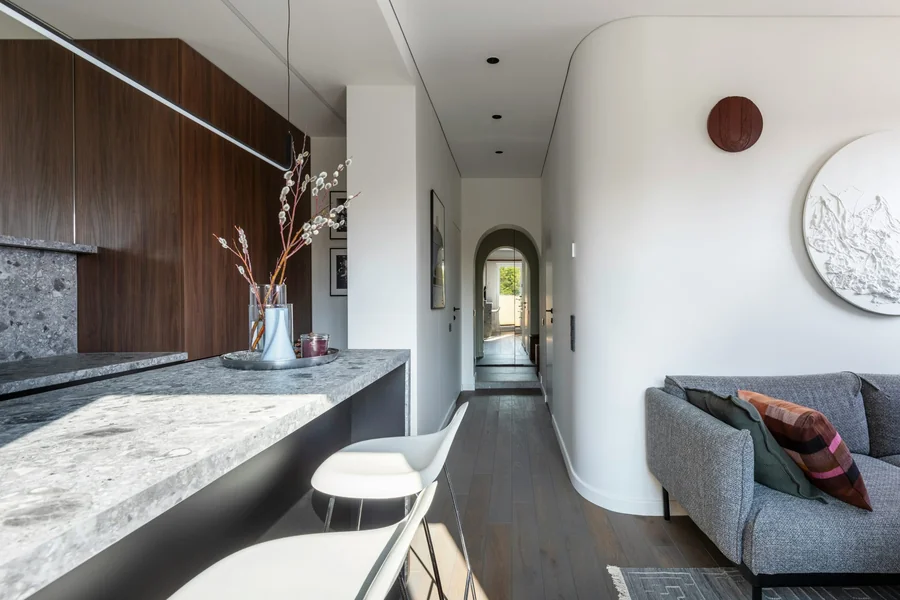
For many, narrow hallway is more of an obstacle – a tiny space that is difficult to make both cozy and beautiful. These connective passages are often treated as leftover space, yet they set the emotional tempo of a home, offering the first glimpse of its character, then carrying it from room to room. The trick is to understand how to work with linear spaces.
Make the Floor the Opening Act
When there is little room to broaden the architecture, give the eye somewhere beautiful to travel. A patterned runner, laid almost wall to wall, makes the corridor feel intentional and softens its acoustics underfoot. Choose a design with a strong central line or an elongated repeat; it visually pulls the space forward instead of cutting it into short, nervous sections.
For a more permanent gesture, a mosaic floor in a restrained palette can deliver the same sense of procession with considerably more gravitas. Think limestone, warm ivory, ink blue, or oxblood rather than a riot of competing tones.
Treat the Ceiling as a Fifth Wall
Narrow halls are frequently short on width but generous in height, which makes the ceiling a particularly persuasive canvas. A lacquered finish, a papered ceiling, or paint carried seamlessly up and over the walls can turn a merely functional corridor into a small theatrical moment.
A pale ceiling above white walls often calls attention to the corridor’s proportions; a single enveloping treatment makes the boundary between wall and ceiling recede. In a period home, a delicate cornice picked out in a slightly deeper shade is a lovely way to make the architecture stand out.
Use a Gallery Wall With a Clear Rhythm
A hallway is literally made for exhibiting art. Rather than treating it as a place to hang every unframed family photograph, choose one visual language: black-and-white photography, botanical studies, antique engravings, or contemporary works on paper.
Hang frames on a consistent centerline (typically around 57 to 60 inches from the floor to the artwork’s center) and keep the spacing consistent. That regular cadence gives a slim corridor a sense of order, while the changing images reward the slow walk through it.
Borrow Light With an Oversized Mirror
A mirror is the oldest hallway trick in the book, and still one of the most effective. Position one opposite a doorway, window, or bright room so it has something worthwhile to reflect. A tall, slender antique glass adds depth; a broad horizontal mirror can make a particularly tight entry feel wider.
Avoid mirrors that are too small. It will only make the space look smaller. One substantial piece, with a sculptural frame in aged brass, ebonized timber, or plaster, is more convincing than a collection of decorative fragments.
Choose Shallow, Architectural Storage
The most successful narrow-hall storage is barely visible. A bespoke cabinet only 8 to 10 inches deep can accommodate keys, umbrellas, scarves, post, and all the small things that tend to colonize an entrance. Painted to match the wall, it becomes architecture rather than furniture.
If built-ins are not possible, opt for a slim console with open space beneath it. A floating shelf is another elegant option, especially when paired with a low-profile lamp and one beautiful bowl. The aim is not to fill the corridor but to create breathing space while increasing functionality.
Layer the Lighting Like a Proper Room
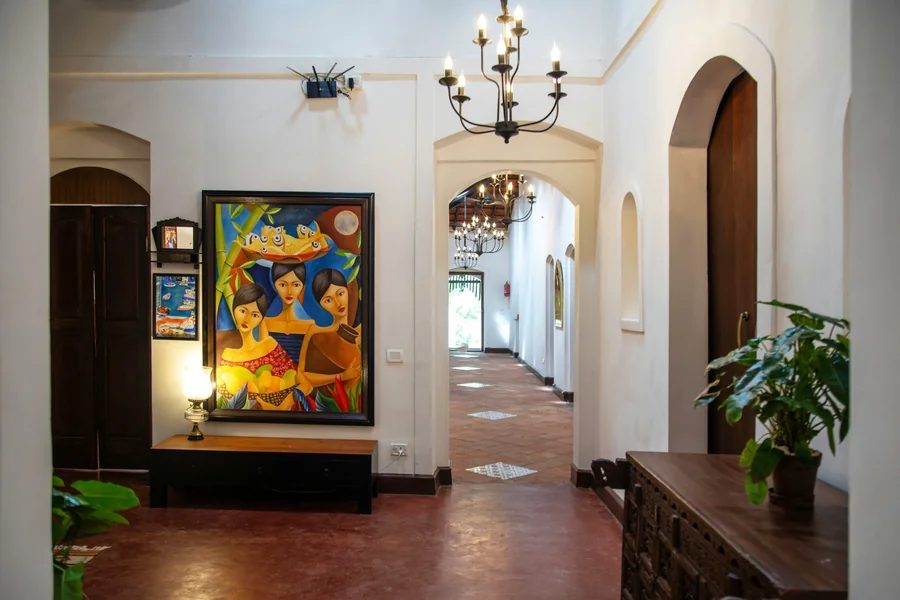
One central flush mount rarely flatters a long, narrow hall. It creates a bright pool in the middle and leaves the ends in shadow. Instead, layer illumination as you would in a sitting room: soft ambient light overhead, gentle wall lights to animate the vertical plane, and perhaps a small lamp on a console for evening warmth.
Wall sconces are especially useful because they illuminate faces, artworks, and texture without stealing floor area. Set them at a considered height and select shades or diffusers that conceal the bare bulb.
Go Deep With Colour
A narrow hallway can handle more colour than most people think. In fact, a saturated hue often feels more sophisticated than a tentative neutral because it turns the space into a distinct experience. Olive, tobacco, midnight blue, aubergine, and dusty brick all bring visual depth without requiring a single additional inch of space.
Try colour drenching – using the same shade across walls, trim, and doors – for a particularly cocooning effect. The uninterrupted field blurs awkward corners and makes the hallway feel calm, not cramped.
Introduce One Element of Real Texture
Texture lends a corridor the richness that square footage cannot. Grasscloth wallpaper, limewash, timber panelling, ribbed plaster, or a tailored wool runner will make the journey between rooms feel more tactile and alive.
Keep the palette relatively quiet if the texture is visible. A hallway should have atmosphere, but it should not ask guests to decode ten ideas at once. One material with a strong hand is usually enough.
Create a Destination at the Far End
Long corridors can feel like tunnels when there is nothing to draw the eye onward. Give the end wall a purpose: a moody painting, a vintage chair beneath a picture light, a sculptural pedestal, or a jewel-box wash of colour. It creates an endpoint and makes the hallway feel composed from both directions.
This is also where a small mosaic medallion can be exceptionally effective, especially in a tiled entrance or a transition between old and new parts of the house. It can create a distinctive spot in the hall design, adding craft aesthetics and uniqueness to any hallway.
Let the Doors Join the Conversation
In a narrow hallway, doors are not just a background: they can account for much of the visible wall area. Paint them to match the walls for an enveloping, seamless effect, or choose a contrasting high-gloss shade to turn them into graphic punctuation. A run of identical doors gains enormous presence when hardware is upgraded to unlacquered brass, bronze, or hand-finished nickel.