







Electrical Busbar Technology: Efficient Power Distribution in Modern Electrical Systems
Modern electrical distribution systems need to move large amounts of current while keeping equipment organised, accessible and thermally stable. Traditional wiring can become increasingly difficult to manage as the number of circuits grows, particularly inside…
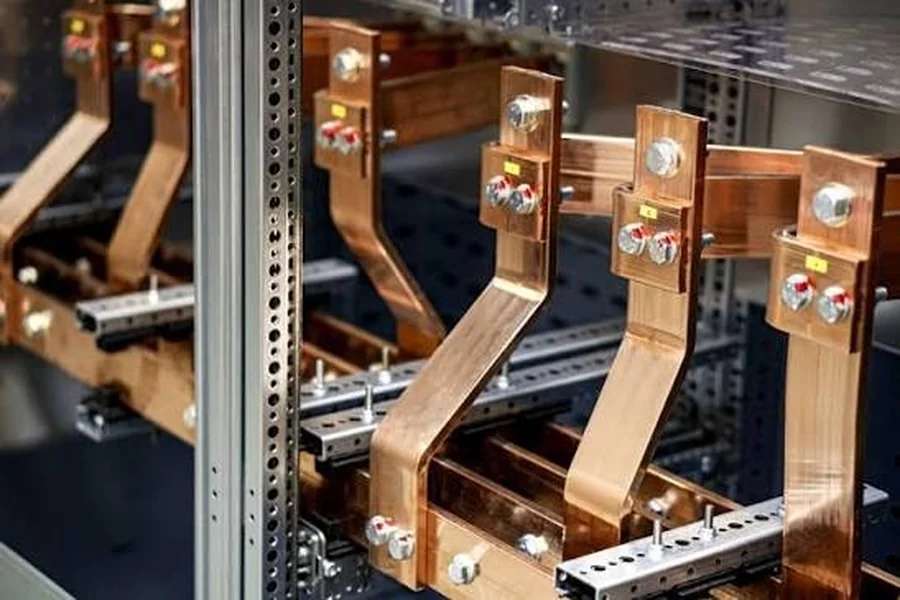
Modern electrical distribution systems need to move large amounts of current while keeping equipment organised, accessible and thermally stable. Traditional wiring can become increasingly difficult to manage as the number of circuits grows, particularly inside distribution boards, switchgear, control panels and industrial power systems.
An electrical bus bar provides an alternative approach by using a conductive metal bar or engineered busbar assembly as a common electrical distribution point. Instead of routing separate cables between every connected circuit, a busbar creates a structured low-impedance path through which multiple circuits can receive power.
RS Hong Kong’s busbar range includes copper, brass and aluminium solutions, as well as complete busbar systems and accessories from manufacturers such as Schneider Electric, Siemens, ABB and Eaton.
How a Busbar Distributes Electrical Current
The primary reason of a busbar is to serve a common electrical connection.
A feed electrical supply is connected to the busbar, and there can be several outgoing circuits that connect to the conductive structure. In 3-phase systems, the individual phases can be represented by separate conductors, and neutral and earth systems may be added based on the system design.
Such a method minimizes the routing of individual cables within the electrical equipment. It is also able to simplify the distribution layout since circuits are laid around a predetermined conductive system as opposed to a huge mass of individual cables.
This formal arrangement can come in handy especially when multiple protective devices require a common supply in case of switchgear and distribution equipment.
Copper and Aluminium as Busbar Materials
Electrical resistance, mechanical strength and thermal behaviour are all directly related to the selection of material.
Copper is a common material due to its ability to conduct a lot of electricity and good mechanical properties. It is capable of giving an efficient current flow and the conductor size is relatively small.
Alternatives are also available in the form of aluminium whereby weight and material factors are considered. Copper and aluminium are based on the current requirement needed, size, where it will be installed and the general design of the system to use.
RS Hong Kong maintains the list of copper and other conducting material products, the specifications of which differ depending on the usage. An example ABB copper busbar advertised by RS is 80 × 10 × 2000mm, and rated at 1450A.
Current Rating and Thermal Performance
Current rating is one of the greatest busbar specifications.
Electrical conductors heat up when a current is passed through it. Heat is determined by the factors such as current, conductor resistance and operating conditions. With higher current, the thermal management becomes a factor of importance.
The physical cross-sectional area of a busbar thus directly relates to the current carrying capacity. Large conductive surfaces have the ability to offer reduced resistance and increased heat-dissipation.
Temperature rating should also be taken into account since current carrying capacity of a busbar may be affected by ambient temperatures and how it is installed. An example of a Schneider Electric three-phase Acti9 busbar available as listed by RS is rated at 100A, 40 C at 415 V AC, and it has a 18mm pitch.
Phase Configuration and Pitch
Circuit-breaker assemblies commonly use busbars which are configured to particular phase arrangements.
Depending on the electrical architecture, single-phase, two-phase, three-phase and four-phase designs are available. The spacing between connection points and the number of poles should correspond to the equipment, on which the busbar should be used.
Combusbars that are designed in the form of a comb are especially sensitive to pitch. It determines the distance between the points of connection and has to be in line with the circuit breakers or protective devices that are installed.
Examples are in RS listings: including 9mm, 18mm and 27mm, 36mm, 40mm and greater size depending on system.
When the right pitch is chosen, it will not lead to any installation difficulties and the busbar will be properly aligned to the terminals of some other protective devices.
Insulation and Touch Protection
An electrical hazard can be a serious one when a conductive bar is in its bare form and it is accessible when operational. Busbar systems thus often include insulation, barriers, covers or enclosed assemblies.
There are two uses of insulation; insulation prevents accidental contact and minimizes the chances of accidental electrical connection between adjacent conductors.
Certain busbar products have a protective cover or end pieces. As an example, a Schneider Electric Acti9 busbar with IP20 end pieces and tooth covers, which is offered by RS, has insulating components made of halogen-free plastic.
The relevant level of protection should be determined by the installation environment and relevant electrical standards.
Mechanical Strength and Short-Circuit Forces
Busbars are not required to conduct only current, but also to resist the mechanical forces that may arise during fault conditions.
Short circuits may generate very large currents, generating serious electro-magnetic fields between the conductors involved. Mounting arrangements and busbar supports must thus be built to ensure spacing of the conductors and mechanical stability.
This is particularly essential in large current switchboards as well as in industrial distribution systems. The size of the conductors, the spacing between supports, the design of the enclosure and eventual fault current are all factors that add up to the general mechanical requirements.
In the case of specialised systems, engineers should thus take into account short-circuit withstand capability, not just choosing a busbar based on its continuous current rating.
Flexible and Rigid Busbar Designs
Rigid busbars are highly applicable in fixed switchgear and distribution units where there is a fixed physical relationship between the connected portions.
Busesbar conductors may be more appropriate to be flexible in cases where equipment vibrates, moves or expands. Information on busbars in RS also specifically separates rigid bar busbars in permanent installations, and flexible conductors in cases where movement or thermal expansion must be provided.
The connection between discrete pieces of equipment where alignment is challenging can also be made easy by having flexible connections.
Integration With Circuit Breakers and Switchgear
The possibility of being directly connected with protective devices is one of the key benefits of busbar systems.
Comb busbars are used in situations allowing the power supply to be supplied to several miniature circuit breakers or other kinds of devices without having to supply each circuit breaker separately. This produces a more clean panel design and has the potential to eliminate wiring and termination.
Adapters, tap-offs, supports and other accessories are also allowed to be used in industrial busbar systems. The catalogue offered by RS consists of busbar adapters and parts that fit certain switchgear families, which enables engineers to create modular distribution configurations.
It is thus necessary that there be compatibility. The rated voltage, current, pitch, number of poles, phase arrangement and the equipment range that is specified by the manufacturer must be verified prior to installation.
Applications in Modern Electrical Infrastructure
Busbars can be found in numerous electrical systems such as distribution boards, industrial control panels, switchgear, motor-control systems, manufacturing facilities and data centres.
They may be small in structure particularly where a large number of high current circuits is required to fit within a small physical area. The structured design might also streamline the inspection and maintenance procedures as connection points can be discovered with ease.
Larger electrical installations can apply the same concept to larger scale power distribution to building distribution by the use of busbar trunking and related tap-off systems.
Engineering the Future of Power Distribution
The electrical bus bar remains a fundamental technology for efficient power distribution because it combines high-current conductivity with a structured mechanical layout.
Modern systems are becoming increasingly modular, with insulated conductors, configurable tap-offs, protective accessories and compatibility with sophisticated switchgear. At the same time, improved materials and manufacturing processes allow busbars to handle higher currents while maintaining controlled dimensions and thermal performance.
As electrical installations become more power-dense and increasingly automated, busbar engineering will continue to provide an efficient foundation for distributing electrical energy safely and systematically.