


How Do You Add Someone to a Photo With AI? A No-Photoshop Guide (2026)
Someone Photo: Short answer: yes, you can add someone to a photo with AI in about a minute, and you don't need Photoshop. You upload a photo of the…
Short answer: yes, you can add someone to a photo with AI in about a minute, and you don't need Photoshop. You upload a photo of the person and the photo you want them in, and the AI blends them into one natural image, matching the light and angle automatically. Here's how it works, what it costs, and how to get a result that actually looks real.
Quick answers
|
Question |
Short answer |
|
Do you need Photoshop? |
No — the AI blends the photos for you |
|
How long does it take? |
About a minute |
|
Does it add a watermark? |
No — results download in HD |
|
Is the result realistic? |
Yes, if your photos match in framing and light |
|
Can you add a late loved one? |
Yes, as a keepsake composite |
Can you really add a person to a photo without Photoshop?
Yes. The old way meant carefully cutting someone out and pasting them in, which almost always looked off. AI tools do that blending for you. They re-draw the added person to fit the scene's lighting and perspective, so you skip the manual masking entirely — and the result usually looks far more natural than a hand-made cut-out. You do not need any design software, an expensive computer, or editing experience — a browser and two photos are enough.
How do you add someone to a photo with AI?
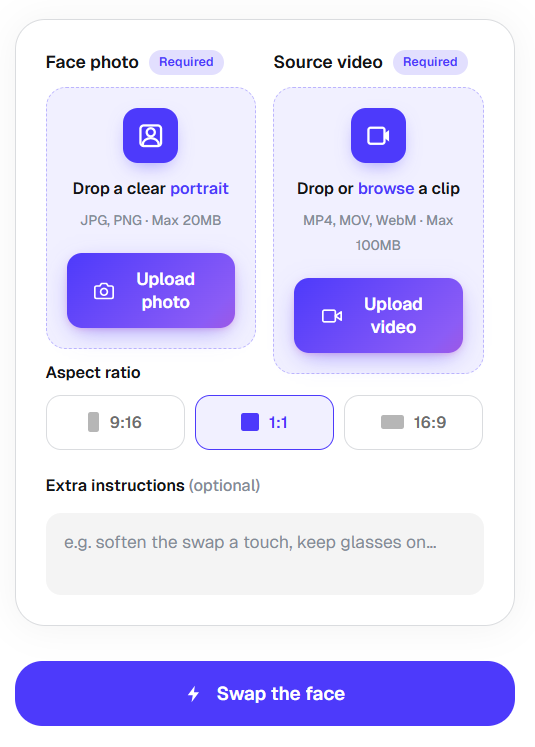
Here's the whole process. You can add someone to a photo with AI right in your browser — no download, no editing experience.
- Upload the person. Add a clear, well-lit photo of the person you want to insert.
- Upload the scene. Add the photo you want them placed into — a group shot, a landscape, anywhere.
- Describe the placement (optional). Type where they should go, like “standing on the right” or “sitting at the table.”
- Generate and download. Pick an aspect ratio, generate, and save the finished image in HD.
Overchat's tool runs on the Seedream 4.5 image model and returns the result, usually in seconds.
Two separate photos blended into one — the AI matches lighting and scale. Source: overchat.ai, July 2026.
How is AI different from doing it in Photoshop?
Mostly speed and skill. Photoshop can produce a great result, but it takes time and know-how. AI trades some manual control for a result in seconds that anyone can make. For most everyday photos, that trade is well worth it; for a magazine cover, a human editor still wins.
|
Method |
Time |
Skill needed |
Cost |
|
AI add-person tool |
About a minute |
None |
Free to start |
|
Editing it yourself in Photoshop |
30–60 minutes |
High |
Paid software |
|
Hiring a photo editor |
Hours to days |
None |
Paid per image |
What photos give the most realistic result?
The result is only as good as the two photos you start with. Three things matter most.
Matching the framing is the big one: pair a headshot with a headshot and a full-body photo with a full-body scene. If the person photo shows less than the scene needs, the AI has to guess the missing parts, and that's where results wobble.
Is it free, and how much does it cost?
Create a free Overchat account, and results download in HD. For tricky jobs — unusual angles or big differences in scale — pro models handle the perspective matching better, and, as with most AI editors, heavier use moves you to a paid tier. For a one-off family photo, the free route is usually plenty.
What can you use it for?
Plenty, and not just sentimental projects. The common ones: adding a relative who missed a gathering to the group photo, dropping a friend who couldn't make the trip into the shot, placing a late loved one into a new family picture as a keepsake, or making playful edits and creative composites. Wedding and event photographers also use it to fix a shot where someone was missing, and small businesses use it to build clean product or team photos without a reshoot.
Is it okay to add someone to a photo like this?
For personal keepsakes and fun, yes. The sensible rule is honesty: if you add someone who has passed or who wasn't really there, let the people who'll see it know it's a created image rather than an original photograph. Keep the source files, and don't use a composite to mislead anyone. Used openly, it is a warm way to complete a memory rather than a trick, and most families treat the result exactly that way — as a keepsake to share, not a document to pass off as original.
Common mistakes to avoid
A few habits cause most disappointing results. The biggest is mismatched framing — dropping a headshot into a full-body scene, which forces the AI to invent a body. Others include photos lit very differently, such as a flash-lit indoor shot placed into a soft outdoor scene, a blurry or low-resolution person photo, or a face that is partly hidden. Give the model a clear face, a similar shooting angle, and a quick note on placement, and most of these problems simply disappear.
Overchat does much more than add people to photos
If you land on Overchat for this, it's worth knowing the add-person feature is one small piece. Overchat AI is an all-in-one app with 150+ purpose-built tools for image, video, audio, and text, powered by the latest models from GPT, Claude, Gemini, Grok, Kimi, and Qwen. The same account can restore an old photo, write a caption, or turn a picture into a short video.
That's the quiet advantage. Instead of paying for ChatGPT, Claude, and Gemini as three separate subscriptions, you reach all of them through one interface for a lower combined cost. It runs on web, iOS, and Android and is used by more than 350,000 people — many of whom came for a single edit and stayed for the rest.
Frequently asked questions
How do you add someone to a photo with AI?
Upload a photo of the person and the photo you want them in, optionally describe where they should stand, then generate. The AI matches the lighting and perspective and gives you an HD image to download, usually in under a minute.
Do you need Photoshop to add a person to a photo?
No. AI tools handle the cutting out, scaling, and lighting automatically. You upload two photos and download the finished result — no manual masking or editing skills required.
How long does it take to add a person to a photo?
Around a minute. Most of that is uploading your two photos; the AI generates the combined image in seconds, and you can regenerate if the pose or placement isn't quite right.
Will the result look realistic?
Usually, yes — as long as your two photos match in framing and lighting. A clear, sharp photo of the person and a scene shot from a similar angle give the AI the most to work with.
Can you add a person who has passed away to a photo?
Yes, many people do this as a keepsake. Use a clear photo of them, match the framing to the scene, and be open with family that the final image is a lovingly made composite.
Is it safe to upload my photos to an AI tool?
Use a service you trust and read its privacy terms. Reputable tools let you download your result and delete your uploads, and it is wise to avoid sending sensitive images to any editor you are unsure about.